
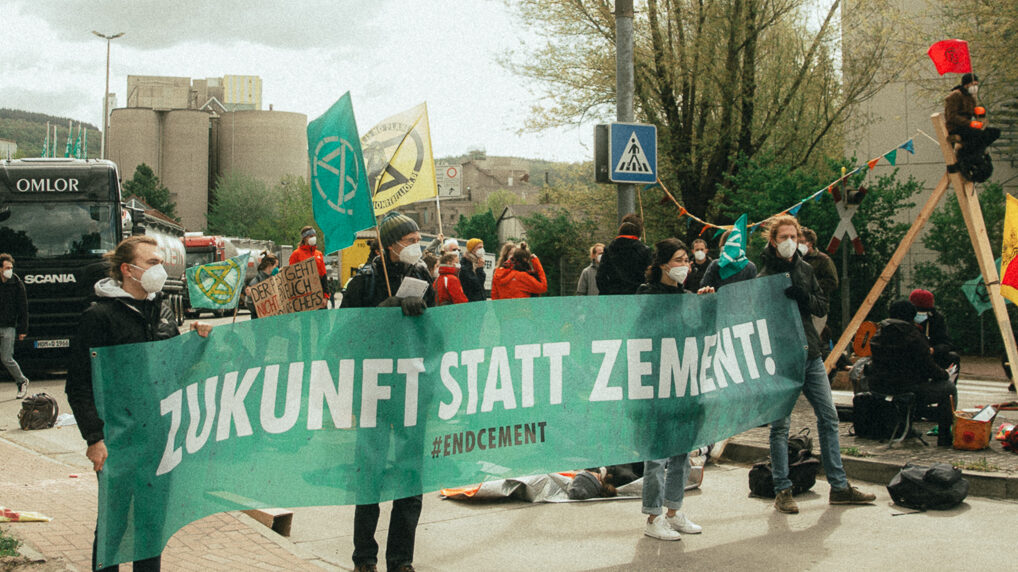
Hence cement is so bad
The climate crisis has begun.
This is also due to the gigantic emissions from the cement industry: 8 % Global CO2 emissions. That is double As much as all of Africa and almost three times the air traffic!
Nevertheless, the cement industry does not play a major role in the public climate debate at the moment and HeidelbergMaterials in particular can present itself to the outside world as a "green" company. And this despite the fact that it came in 2023 in the CO2 emissions in place 1 of all DAX companies.
Cement is Fossil
1. In the production of cement, very High temperatures for which coal is often used.
2. Even more serious, however, is that the processing of limestone into clinker always necessarily releases CO2 – this alone chemical process It is responsible for roughly half of industrial emissions. These emissions are much harder to control because they are necessarily emitted in production.

██
All countries that emitted less CO2 in 2019 than the cement industry.
GREENWASHING OF INDUSTRY
The European cement industry likes to present itself to the outside world as a pioneer in terms of climate protection. HeidelbergMaterials in particular, the largest German cement manufacturer, is at the forefront, among other things with the advertising slogan "Echt. Stark". Green.
However, it has no plan for how to act in accordance with the Paris climate agreement. Its two main solutions are: alternative fuels designed to replace coal, and CCS.
But behind the concept of alternative fuels is nothing else than: waste. From waste tyres to sewage sludge and waste oil to crushed animals, the amount of incinerated waste in cement plants is steadily increasing and not only ensured that waste incineration was exempted from regulations, but also Millions of profits of cement manufacturers.
CCS, on the other hand, is carbon capture and storage – the capture of the remaining emissions and the subsequent storage, which is usually to happen under the seabed. There are risks everywhere:
- In order to capture the CO2, new, expensive technology is needed at the cement plants, which not only energy consumption would triple, but also for Additional particulate matter, nitrogen oxides and ammonia emissions can worry.
- And since very few cement plants happen to be located directly at CO2 storage locations, not only trucks, but also ships, trains and an entire pipeline network would be necessary for CO2 transport. This shall: According to the wishes of industry In Germany alone, it will be almost 5000 km long and newly built with around 14 billion euros. The CO2 must be brought either to very low temperatures or to correspondingly high pressure for transport. This not only swallows a lot of energy, but can also be dangerous in accidents, such as . When a nearby CO2 pipeline burst in February 2020, the city was shrouded in a toxic cloud and apocalyptic scenes played out, in which at least 45 people had to be hospitalized despite quick help.
- Storage, which is usually to take place under the seabed, also poses considerable risks and problems for the technology. Since the geological formations are difficult to estimate and the CO2 interacts with the rock, Leaks in storage likely Releasing.
- In order to better assess the risks, long-term, large-scale experiments are needed. Especially since these are potential dangers due to the increasing effects of the climate crisis, such as hurricanes and warm waters can be additionally reinforced. At the same time, however, time pressure is very high; alone The cement industry calculates from 2050 with about 1.37 billion tons, which would have to be stored every year.
- With these challenges, it is no wonder that CCS expansion is progressing significantly slower than planned and Most of the planned projects Failure. Today, only 41 CCS plants are in operation, of which in turn 70% enhanced oil recovery projects, i.e. serve to additionally exploit existing oil deposits and thus extract further fossil raw materials.
- With this starting position is estimatedIn 2050, only about 0,7 billion Tons per year could be stored – if the oil projects are taken out, even only 0.07-0.3 billion tons per year. In other words, a maximum of just one-fifth of the amount required by the cement industry alone – with considerable additional risks for people and nature.
That cannot be the solution! We must not fall for the greenwashing of the industry, which simply wants to continue as before.
But instead of Conservative industry The EU supports cement companies with free emission certificates. The entire industry has in recent years through free certificates several billion euros made additional profit.
What now?
With currently practiced methods, cement and concrete are not sustainable and can only be niche building materials in the long term.
1. EFFICIENCY – OTHER CONCERN
Cement, water, sand and gravel form the basis of concrete. CO2 emissions come from Of all major parts from the cement. Therefore, it would be a solution to use less cement or alternative binders. And since the emissions in the cement are mainly due to the chemical reaction of the limestone, other materials, such as calcium sulfoaluminate cement (CSA cement), come in.
Calcium hydrosilicates (CHS) and the carbonation of calcium silicate (hydrates) increasingly Consideration.
However, a lot of valuable time could pass before these alternatives are ready for use, which makes the following points all the more important.
Consistency – Less concrete
2.1 Use Healthy and Climate Neutral Materials
It is essential – and quite possible – to use less concrete or to do without the use of concrete altogether.
Wooden houses are one A genuine and proven alternative concrete buildings. Wood is natural, renewable and sustainable, its material properties are lightness and high load capacity. As a carbon reservoir, wooden houses remove permanently harmful CO from the atmosphere2. Thus, timber construction actively contributes to climate protection. In addition to other renewable resources, wood has long been concrete as a building material and must be considered in the production of goods.
2.2 Reuse of concrete
Even today, the majority of the building rubble is reused. However, this is less recycling than downcycling, the quality and functionality is deteriorated. This must be counteracted by real, circular construction. However: This method helps reduce resource consumption, but CO2 emissions remain Almost the same height.
2.3 Components with less concrete
Components that use fewer resources and especially less concrete can also play their part in reducing CO2. Examples These include gradient concrete (in which the concrete composition varies over a component), flat and hollow ceilings or carbon concrete.
SUFFICIENCY – LESS BUILDING
3.1 Critical scrutiny
Not only are valuable and dwindling resources wasted in a demolition and new construction, but also significantly more energy. In the case of Energy balance assessment During the entire life cycle of a building, it is noticeable that by evaluating grey energy, renovation is preferable to any new building, even that of passive houses.
3.2 Building less
For ten years, more apartments have been built in Germany every year; The number of new buildings has almost doubled from 159,000 in 2009 to 286,000 in 2018. In the same period, however, rents in many large cities exploded, at the same time as many affordable apartments are missing as long. This seems absurd, but has system.
80,000 apartments only as investment objects They are usually empty.
It is actually in Germany Sufficient housing – we just need to use it better than to use it as a mere speculative object.
JOIN NOW
Be there
If you want to stay on the ball for future campaigns and actions, sign up for the mailing list!

Write us about: post [at] end-cement.earth
(PGP key for encryption)
Imprint | Cookie settings | Collection of jokes
Thanks for the photos to Daniel KubirskiJoe Pohl and Credo.

